
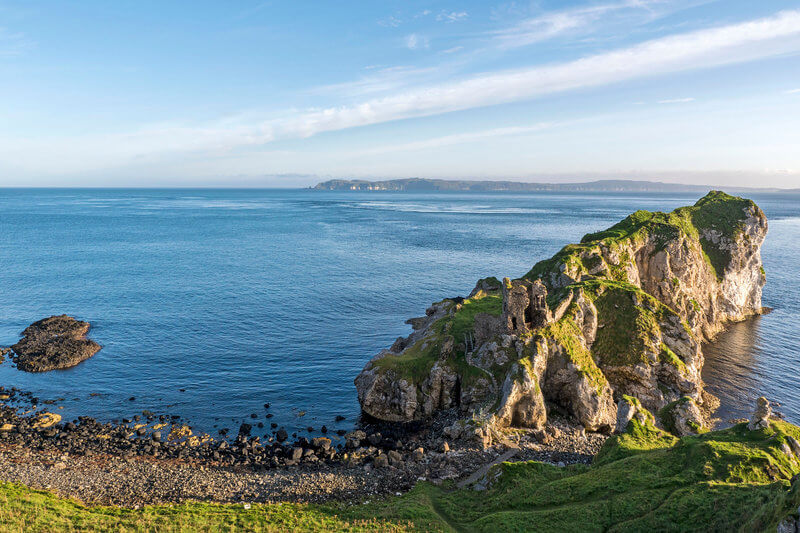
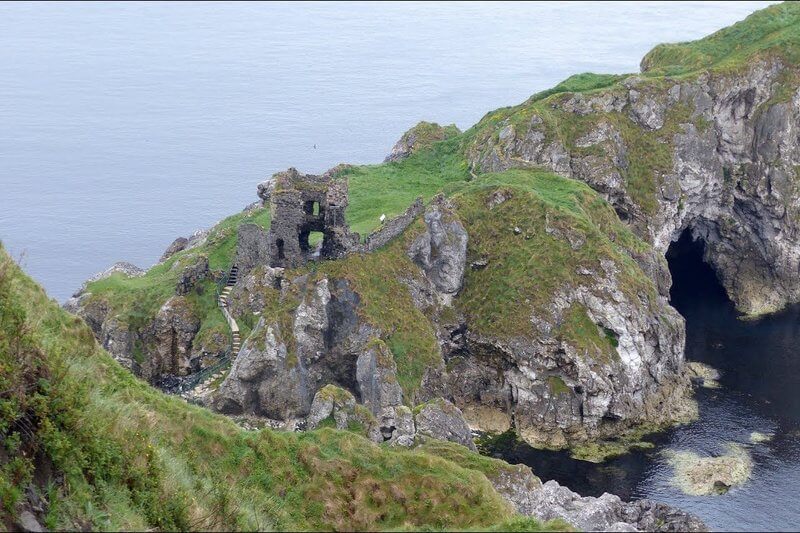
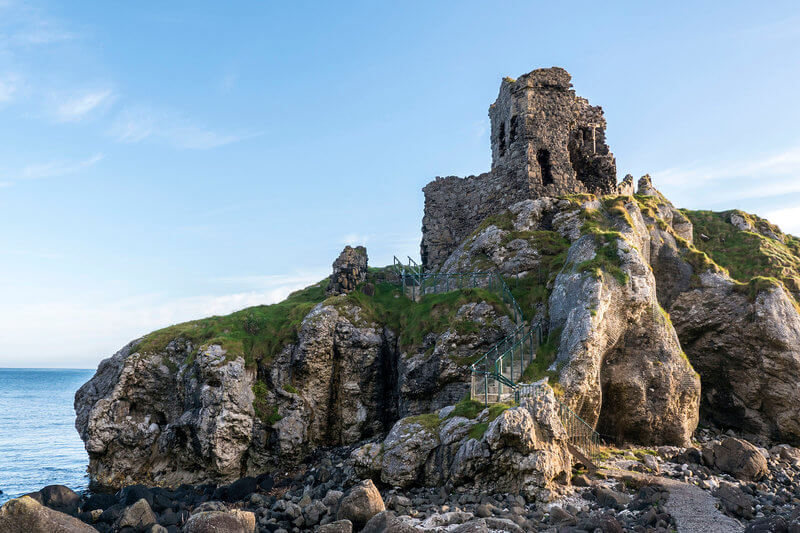
Just west of Ballycastle, the Antrim coastline turns wild and unguarded. Sheer cliffs drop into the Atlantic, and on one of those narrow limestone headlands stands Kinbane Castle, or rather, what’s left of it.
The ruins may seem humble, but this windswept outpost was once a fortress at the heart of Gaelic resistance in 16th-century Ulster.
The name An Ceann Bán, meaning “the White Head,” refers to the pale cliffs that gleam in sunlight and vanish under fog.
It’s a place that feels detached from the modern world. Yet five centuries ago, Kinbane was a strategic watchpoint, a line of defence for the MacDonnells of Antrim, one of the most powerful and ambitious clans in Ireland.
Built In Blood And Strategy
Kinbane Castle was constructed around 1547 by Colla MacDonnell, brother of the renowned chieftain Sorley Boy MacDonnell. The family, descended from Scottish nobility, were expanding their influence along the north coast during a time of constant conflict.
To the English however, they were rebels. To their Gaelic rivals, they were competitors for power.
From Kinbane’s headland, Colla could control the sea route between Rathlin Island and the mainland, a vital passage for trade and reinforcements from Scotland. But the same exposed position that gave the castle its strength also made it vulnerable.
In 1551, English forces under Sir James Croft attacked Kinbane during a campaign to crush MacDonnell influence in Ulster. Cannon fire shattered its walls, and the siege ended in heavy losses. The hollow beneath the cliffs is still known as Lag na Sassenach, “the Hollow of the English,” where legend says many of the invaders were killed.
Colla rebuilt the castle soon after, but in 1555 it fell again to another English assault. Colla himself died here in 1558, and though parts were restored by his kin, Kinbane never fully recovered.
The Struggle For The North
After Colla’s death, Kinbane passed through branches of the MacDonnell family before being granted to their allies, the MacAlisters. For decades, it marked a border between Gaelic Ulster and the growing reach of English authority.
Sorley Boy MacDonnell, Colla’s brother, would later rise to reclaim nearby Dunluce Castle and establish the family’s dominance over Antrim. Kinbane, though, was never rebuilt to its former strength. The storms that roll in from the Atlantic did the rest, slowly tearing down the walls that cannon fire had cracked centuries before.
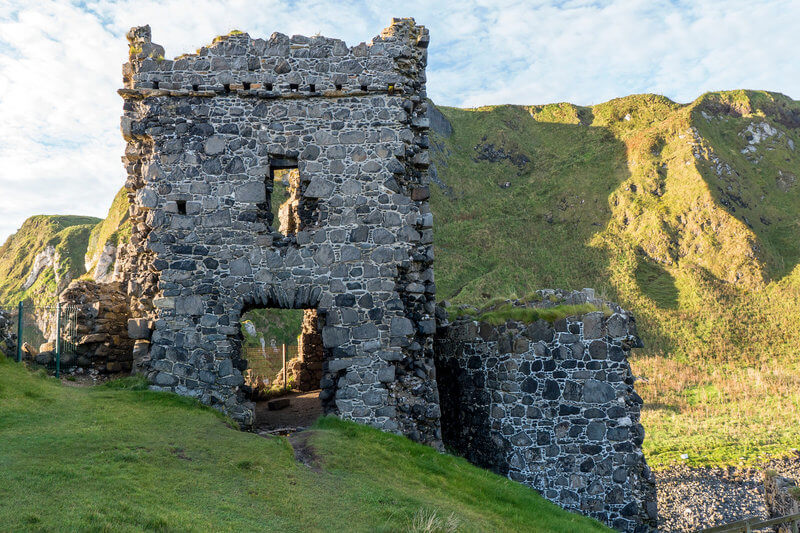
By the 18th century, the castle was little more than a ruin, its stones scattered by time and sea, leaving behind only the skeletal remains we see today.
Visiting Kinbane Castle
To reach Kinbane, follow the steep footpath that drops from the cliff-top car park down toward the sea. It’s not an easy descent, but the reward is a view few places in Ireland can match. Rathlin Island lies on the horizon, the coastline curves away into haze, and the ruins of the castle stand proudly on their slender tongue of land.
The site is quiet and remote. There are no ticket booths, no fences, and no signs breaking the landscape. What remains of the castle are fragments of walls and the ghost of a tower, but the setting gives it a power that no restoration ever could.
Before You Visit
The path down is steep and uneven, and the climb back up can be tough, so wear good shoes and take your time. The best light comes early or late in the day, when the cliffs catch fire with colour and the sea glows deep blue beneath them.
Kinbane sits along the Causeway Coastal Route, just a few minutes’ drive from Ballycastle and Ballintoy. Parking is free, and the site is open year-round.
A Legacy In Stone
Kinbane Castle may not boast tall towers or grand halls, but its story is written in defiance. Built by one of Ulster’s great families and destroyed by cannon fire, it stands as a symbol of the struggle for power, survival, and identity in Ireland’s north.
Even now, the sea continues its slow siege, wave by wave, storm by storm. Yet the cliffs still shine white against the Atlantic, and the ruin remains — weathered, proud, and unbroken.
Kinbane is more than a ruin. It’s a reminder that the toughest places often hold the strongest stories.
Nearby Attractions
While exploring the Causeway Coast, don’t miss other nearby landmarks that share Kinbane’s dramatic history. Visit the hauntingly beautiful Dunluce Castle, perched on its own sea cliff, or the picturesque Ballintoy Harbour, used as a filming location in Game of Thrones.
Both sites are included on our daily Giants Causeway tour from Belfast, the perfect way to discover the wild beauty and history of Northern Ireland’s coast.
- Ballintoy Harbour Information -
The castle suffered heavy bombardment and partial destruction. Colla MacDonnell rebuilt it, but another assault followed in 1555, during which he was mortally wounded. The lower hollow below the cliffs is still known as Lag na Sassenach — “The Hollow of the English.